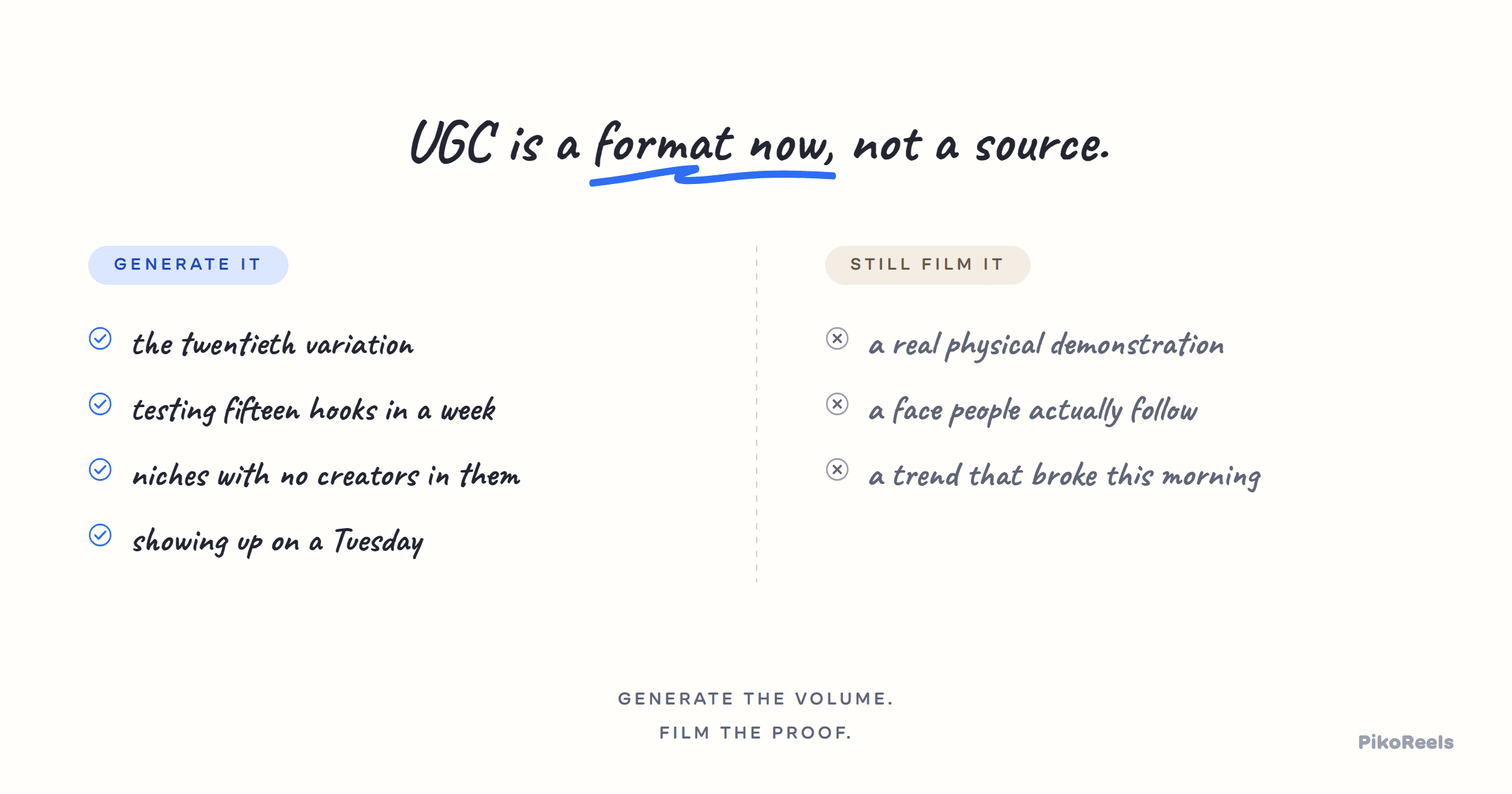
UGC stands for user-generated content: the photos, videos and reviews that customers and creators make themselves, rather than something a brand shot in a studio. In short-form video it usually means a casual clip filmed on a phone, someone talking to camera about a product, instead of a polished ad. AI UGC is that same format, generated instead of filmed.
That is the whole definition, and it is worth being precise about it, because AI UGC is not "an ad made with AI". The point is not the tooling. The point is that it keeps the thing that makes UGC work: handheld, first-person, talking straight to camera, and looking like it came off somebody's phone. What changes is that the creator, the footage and the voice come from a model, which means you can make twenty versions of one idea without booking anybody.
Why the format works
Short-form audiences are not grading your production values. They are deciding, in about three seconds, whether to keep watching. What earns that decision is the hook, the pacing and what you are claiming, and none of those three get better by spending more on a camera. A studio-grade ad in a feed of phone footage does not read as higher quality. It reads as an ad, which is the one thing the format punishes.
Treated as volume plus measurement, AI UGC works well. Treated as one perfect video, it usually doesn't.
That is the real difference generation makes, and it is a difference of economics rather than of quality. If a video costs a day of someone's time, you make one and you hope. If it costs a couple of minutes, you make fifteen, post them, watch which ones hold attention past the hook, and drop the rest. The second approach beats the first almost every time, and it was simply not available to most brands before.
What to actually generate
The formats that work in AI UGC are the formats that already worked in filmed UGC. There is no separate genre. If you are starting from nothing, these are the shapes worth trying first:
- The unboxing. Still the most reliable return on effort in the category, because the payoff is built into the format.
- Get ready with me. A reason to keep talking while the product does its work in the background.
- Before and after. Works when the change is visible in under a second, and fails when it isn't.
- Three things. A list format that survives being cut short, which matters because most viewers do cut it short.
- Talking straight to camera about one objection. The highest-intent format, and the one most brands skip.
Picking from a library of formats with a track record is a shorter path than inventing one, which is what Templates are for. Each one shows an example of how it performed, so the choice is between things with evidence rather than a wall of equally plausible thumbnails.
The labelling rules, as of 2026
AI-generated content is allowed on both TikTok and Instagram. Neither platform bans it. Both want it labelled when it looks realistic, and in 2026 both moved from asking to detecting.
TikTok has integrated C2PA Content Credentials since January 2025, which means it reads provenance metadata embedded in the file by the tool that made it. If it finds those markers it applies an AI-generated label itself, whether or not you switched the toggle on. It has labelled well over a billion videos that way. Disclosure is still the polite thing to do; detection is what actually enforces it.
Meta runs the same play across Facebook and Instagram with its AI info label, which became mandatory for AI-generated content in May 2026. It reads provenance metadata too, and also runs its own classifiers that infer origin from the content itself. On the advertising side, disclosure is now a requirement rather than a courtesy, and undisclosed AI content has become a meaningful share of ad rejections.
The practical upshot is unglamorous: label it. What gets taken down is overwhelmingly the stuff that was not labelled, not the stuff that was. A label costs you nothing in a feed where a large share of what people watch is already synthetic, and an account strike costs you the account. Worth re-checking both policies now and then, because this is the fastest-moving corner of platform rules right now and any article about it, including this one, has a shelf life.
The half nobody talks about
A folder full of generated videos is not worth much. The work that decides whether any of this pays off is posting them, consistently, on a schedule, to every channel you have, and then reading what happened. That is unglamorous and it is where most AI UGC efforts quietly die: the generation gets solved and the publishing does not.
PikoReels does both halves. It generates the footage, writes the caption, cuts everything 9:16, and publishes to TikTok, Instagram Reels, YouTube Shorts on the schedule you set. If you want to see how that compares to the other tools in this category, the comparison pages are written from each rival's own published pricing and dated.